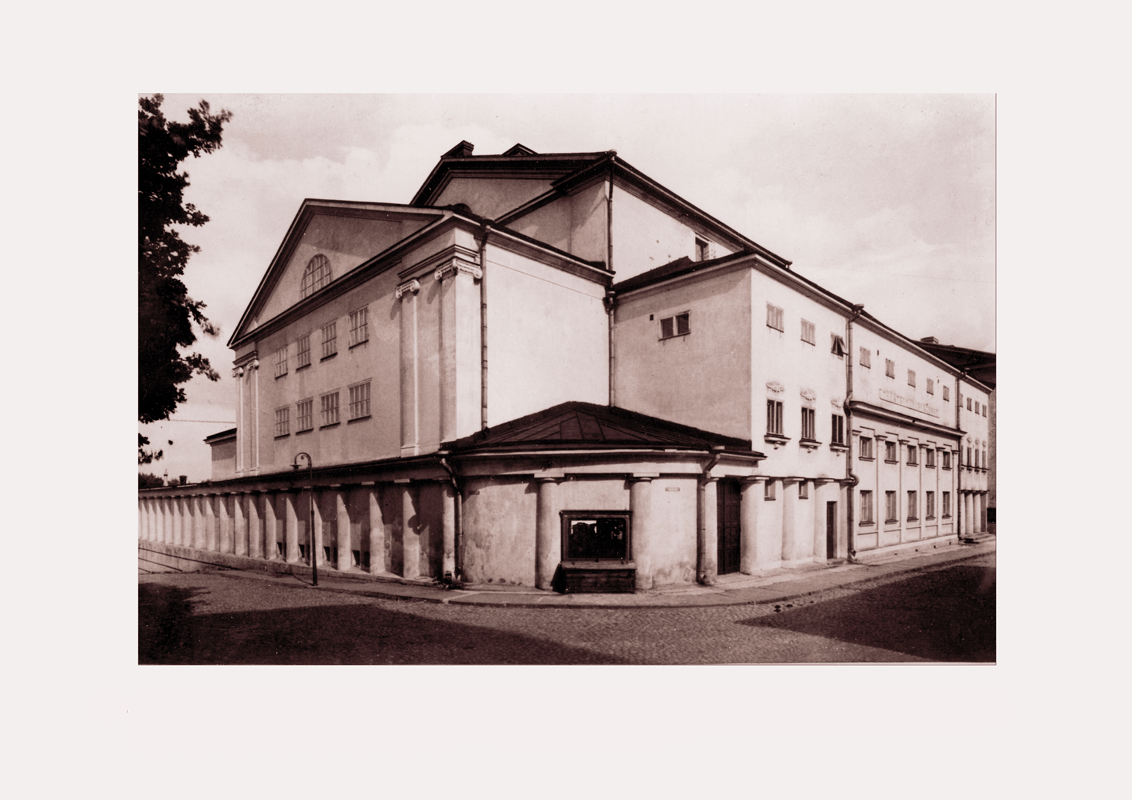
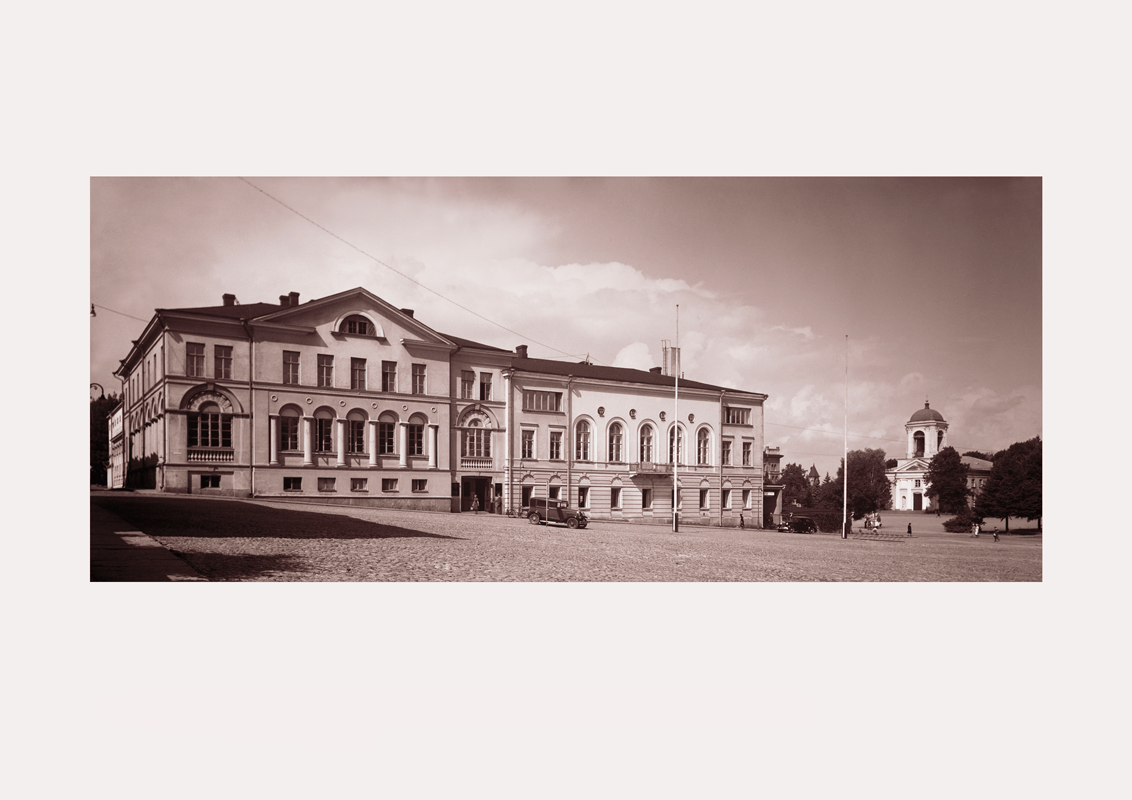
No record remains of the earliest traveling performers who must have toured Viipuri; the first definitive mention of theatre in the city reach back to the plays performed at the Swedish-language school in the 17th century. The venue known as Das Komödienhaus was built at Tervaniemi during the second half of the 18th century; it served both the residents of the city and the Russian officers stationed there. In 1812, Viipuri province was restored to Finland, and Swedish-speaking troupes gradually began to appear alongside touring companies performing in German. In 1832, a stone theatre building opened its doors at the corner of Vahtitorninkatu and Possenkatu streets. The venue was the best in Finland for several decades; the Finnish Theatre Company performed there in December 1872; the following year, the Finnish Opera Company (the lyrical section of the Finnish Theatre Company), gave its opening performance there.
The Finnish Theatre Company was well-received in Viipuri from the start, as the town’s Finnish-speaking population had grown rapidly during the second half of the 19th century. The building underwent repairs at several points (1851, 1881, 1922) and was destroyed in 1941, during the early days of the Continuation War.
Journalist Jaakko Leppo describes the period of the 1930s thus:
In 1899, the building became the permanent home of the Finnish Rural Theatre, a company whose primary sponsor was Juho Lallukka. Two decades and eight theatre directors later, the Finnish Rural Theatre had established itself as the cornerstone of the city’s cultural life. In 1918, the first year of Finland´s independence, the Finnish Rural Theatre changed its name to the Viipuri Stage. The premiere stage in Finland’s second–largest city, it continued to attract a succession of strong leaders: Topo Leistelä (1923–25), Eino Jurkka (1925–28), Otto Al’Antila (1928–31) and Sven Hildén (1931–33).
In 1897, the Viipuri Workers’ Association resolved to sponsor regular dramatic activity, which became a permanent theatre company in 1904 and, in the manner of the workers’ theatres in other large cities, wholly professional in the early 1920s. Strong workers’ stages also emerged in the suburbs of Sorvali, Tammisuo, Kelkkala and Uuras. The Viipuri Workers’ Theatre flourished in particular during the late 1920s, when Arvi Tuomi took over directorship. At that time, the quality of productions often rivalled that of the bourgeois Viipuri Stage.
In the early 1930s, the national government and the city placed a new condition on the bourgeois and workers’ theatres: the division of resources between two professional theatres was to end. In order to continue receiving financial support, they would have to merge.
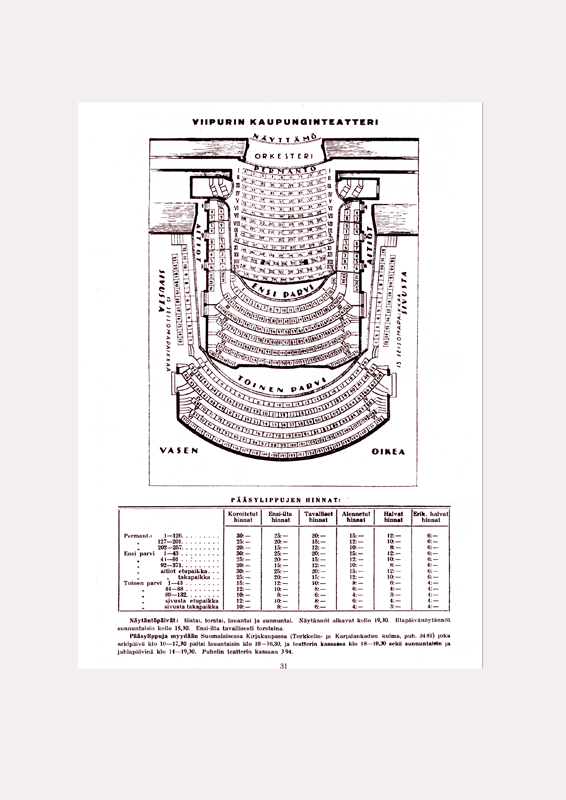
And so, at the beginning of 1933, the Viipuri City Theatre began operations with a strong corps of professional actors. Under the directorship of Arvi Tuomi (1933–38), it held its own against the theatres of Helsinki. Glory Leppänen (1938–40) was director when the Winter War broke out and proved to be its last. When the Finns returned to Viipuri in late August 1941, the building was burning; the ruins stood for at least a decade longer. The Viipuri Wartime Theatre performed during the Continuation War, and the Viipuri City Theatre was formally disestablished in the city of Kotka in 1946.
Many of the actors from Viipuri found work in Helsinki. Set designer Erkki Siitonen continued to create stylish interiors in his work for the Finnish film industry. The Theatre’s collection of plays is currently housed at the library of the Theatre Academy of the University of Arts Helsinki, while other documents are kept at the Provincial Archives of Mikkeli and, in the case of the Viipuri Workers’ Theatre, at the Workers’ Archives. A wide selection of photographs is available in the archives of the Theatre Museum and the South Karelia Museum.
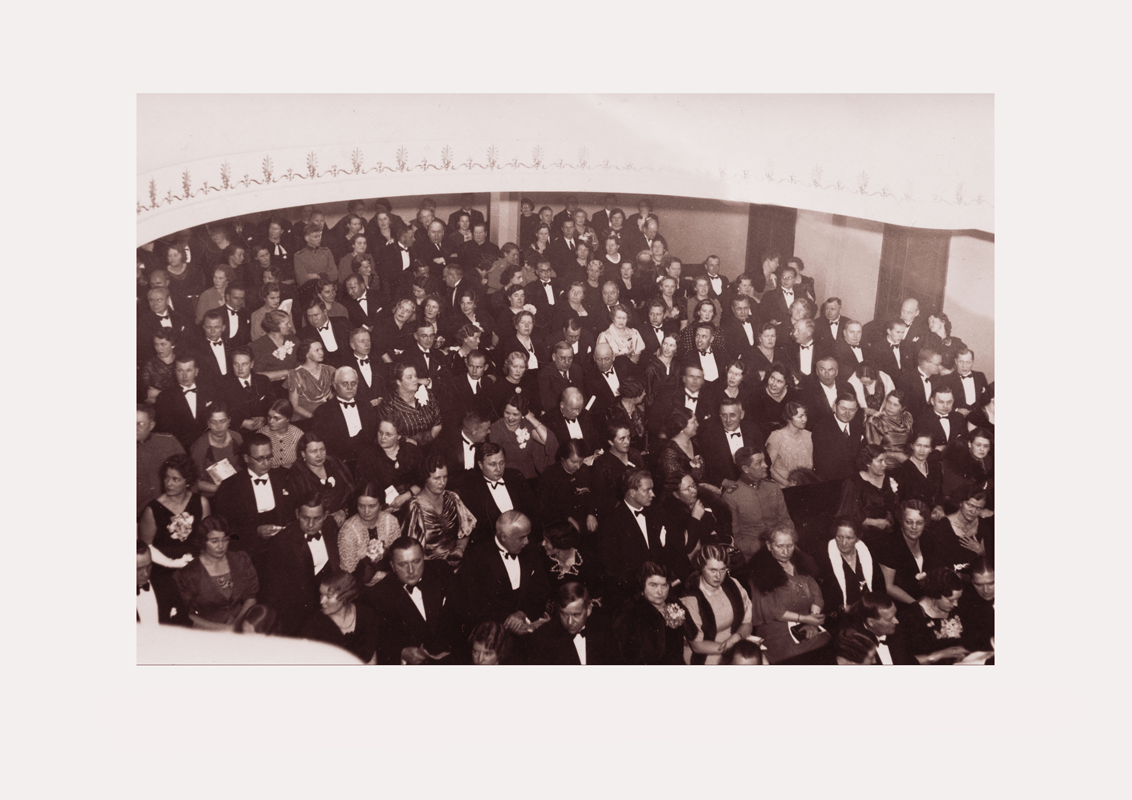
The theatre audiences of Viipuri were appreciative, engaged, and generous with both laughter and tears: so say all who remember it. Kersti Bergroth writes:
| mid-1700s | ”Das Komödienhaus” is built at Siikaniemi. |
| 1832-34 | Construction of the Viipuri theatre and the Seurahuone social club (architect A. F. Granstedt). German-speaking theatre and opera companies from the Baltics and St Petersburg arrive in Viipuri, while Swedish-speaking companies arrive via Stockholm, Turku, and Helsinki. |
| 1868 | Russian companies start performing regularly in Helsinki. No survey exists of possible tours to Viipuri. |
| 1872 | In December, the Finnish Theatre Company (currently the Finnish National Theatre) performs in Viipuri for the first time. |
| 1873 | During the autumn season, the Finnish Opera Company (the lyrical section of the Finnish Theatre Company) is established; its first performances (Lucia di Lammermoor, Il Trovatore) are seen in Viipuri. |
| 1880s | The Finnish Theatre visits Viipuri almost every year. |
| 1888–98 | The Finnish Popular Theatre, a touring theatre company (director August Aspegren), performs frequently in Viipuri. |
| 1897 | The amateur Dramatic Club of the Viipuri Workers’ Association is founded. |
| 1899 | The Finnish Rural Theatre rises on the foundations of the Finnish Popular Theatre, with Viipuri as its hometown. Juho Lallukka is a significant patron. |
| 1904 | The semi-professional Viipuri Workers’ Theatre is founded. The theatre operates on the stage of the Workers’ Association premises (Punaisenlähteentorinkatu 10). |
| 1918 | The name of the Finnish Rural Theatre is changed; the new name is the Viipuri Stage. |
| 1925–26 | Arvi Tuomi acts on the Viipuri Stage. |
| 1926–32 | Arvi Tuomi assumes the roles of theatre director, director, and actor at the Viipuri Workers’ Theatre. |
| 1933 | The Viipuri City Theatre is established. The City Theatre was founded through the merging of the Viipuri Stage and the Viipuri Workers’ Theatre. |
| 1932–33 | Arvi Tuomi assistant director. |
| 1933–38 | Arvi Tuomi director. |
| 1938–40 | Glory Leppänen director. |
| Aug 29, 1941 | The theatre is burning when Finnish soldiers return to Viipuri. |
| 1941–42 | The Viipuri Wartime Theatre (Antero Suonio and Uno Wikström, directors) is housed in the old library (Punaisenlähteentorinkatu 6). |
| 1942–46 | The Viipuri City Theatre operates in Viipuri and, upon ending of the war, on tour from Kotka, where it is disestablished. |
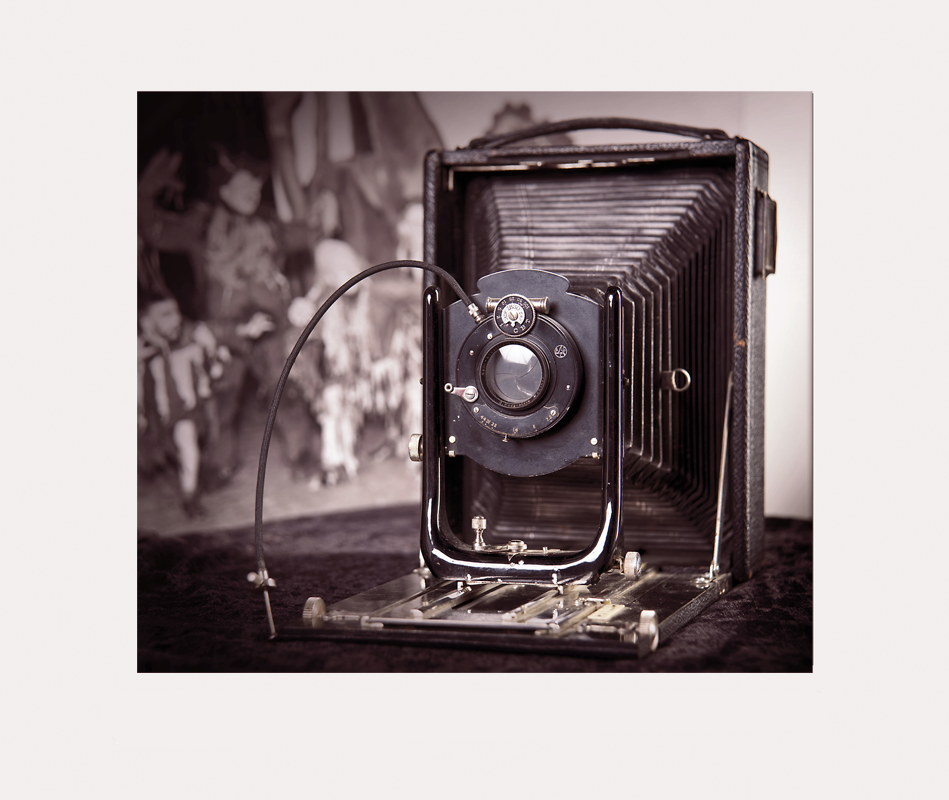
Photographer Eino Partanen (1902–1962) recorded the Viipuri theatre scene for a period of ten years (1929–39). His images offer a visual record of not only the professional theatres, but of the Sorvali Workers’ Stage as well. All negatives of Partanen’s theatre images have been lost. The majority of pictures appearing in this exhibition have been digitized from postcard-sized photographs Viipuri residents purchased of their favourite performances. These postcards served as advertisements for the theatre and were sent to friends, who later donated them to institutions such as the South Karelia Museum in Lappeenranta. Images showcasing Viipuri theatres also appear in several individual collections, including a gift from the Wiipuri Archives Society, held at the archives of the Theatre Museum in Helsinki. The actors Rauli Tuomi and Liisa Tuomi, children of the theatre director Arvi Tuomi, launched their careers in Viipuri, and Liisa Tuomi’s family archives contain a wealth interesting images, many of which have been selected for use in this exhibition. Despite the fact that other photographers also photographed productions in Viipuri, this exhibition features only those taken by Partanen and stamped Helios Oy. The photographs used were chosen on the basis of their photographic quality and the representativeness of their contents. This online exhibition was adapted from an exhibition shown at the Hermitage–Vyborg Exhibition Centre during summer 2012, the Finnish Institute in St. Petersburg in autumn 2012 and the Theatre Museum in 2013. That exhibition was a tribute to Eino Partanen by his daughter, the photographer Aila Teräväinen. Teräväinen passed away in 2015.